
Educational Psychology Resources
There is some discussion among practicing educators about the importance of studying educational psychology. One way to think about this issue is to define some terms.
Education can be defined as the process of developing the capacities and potential of the individual so as to prepare that individual to be successful in a specific society or culture. From this perspective, education is serving primarily an individual development function. On the other hand, education can be seen as serving a social and cultural function and could be defined as the process by which society transmits to new members the values, beliefs, knowledge, and symbolic expressions to make communication possible within society.
Similarly, psychology can be defined as the scientific study of the mind and behavior (or behavior and mental processes), especially as it relates to individual human beings.
Educational psychology, then, is a combination or overlapping of two separate fields of study. The first is psychology. Note that it is the scientific study of mind or mental processes (covert or internal) as well as behavior (overt or external). People who study psychological phenomena are not necessarily limited to the study of human beings (a large body of research relates to animals) nor are they limited to only studying individuals. However, when studying groups of individuals, the focus is generally on how individuals perform within the group rather than the study of the group as a whole.
The materials on this section of the website focus on components of the teaching-learning process as shown in this model.
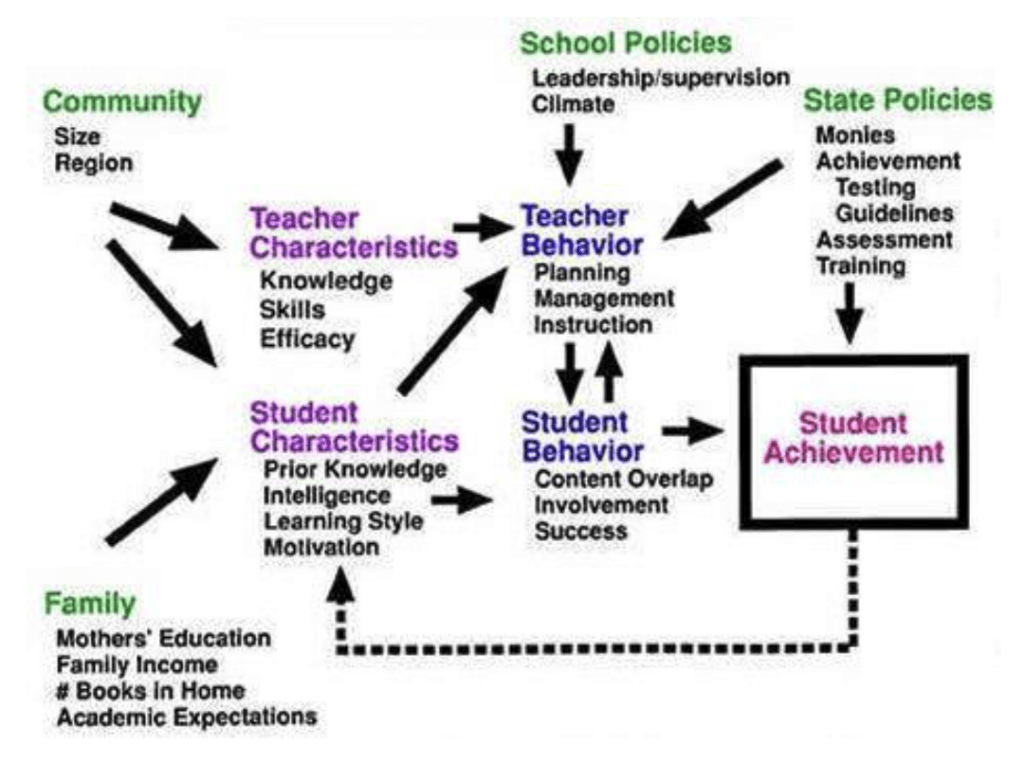

These are divided into fifteen chapters.
- Introduction
- Why study educational psychology
- History of educational psychology
- Overview
- Frameworks
- Curriculum development
- Human Development
- Holistic development — Brilliant Star Framework
- Piaget
- Theory of cognitive development
- Practical applications
- Vygotsky’s theory of cognitive development
- Erikson theory of socioemotional development
- Individual Differences (Part 1)
- Intelligence
- Motivation
- Moral character
- Individual Differences (Part 2)
- Disabilities
- Gifted
- Behavioral Learning Theory
- Overview
- Classical Conditioning
- Operant Conditioning
- Using operant conditioning
- Schedules of reinforcement
- Behavior modification
- Cognitive Information Processing
- Overview of theories
- Using information processing theory
- Mental representations
- Critical and creative thinking
- Metacognition
- Affect Oriented Theories
- Humanism
- Invitational education
- Positive psychology
- Socially Oriented Theories
- Social learning theory
- Social cognitive theory
- Connectivism
- Teacher-led Classrooms
- Planning
- Teacher-led instructivism
- Classroom management
- Learner-centered Classrooms
- Constructivist instruction
- Classroom discipline
- Assessment and Evaluation
- Overview
- Formative evaluation
- Standardized testing
- Research Methods
- Overview
- Qualitative methods
- Quantitative methods
- Research Findings
- Improving student achievement
- Improving learning strategies
- The Changing Context
- Technology
- Sociocultural change
Note: There would be introductory text for each chapter with buttons for:
- Short overview video
- Readings